
Want to meet Mike? Mike will tell you everything you need to know to enjoy your best-tasting tomatoes ever, and answer all your growing questions in a free lecture and Q&A from 1:30 to 3 p.m. at Behnke鈥檚 5th Annual Garden Party event on Saturday, June 6. for details.
Who spit on my shrubbery?聽
Gwen in Middleburg sent us a photo of a healthy looking plant with a big mass of frothy white material between two of the branches and asks, 鈥淐an you ID this nasty stuff on my Moonbeam Coreopsis?鈥�
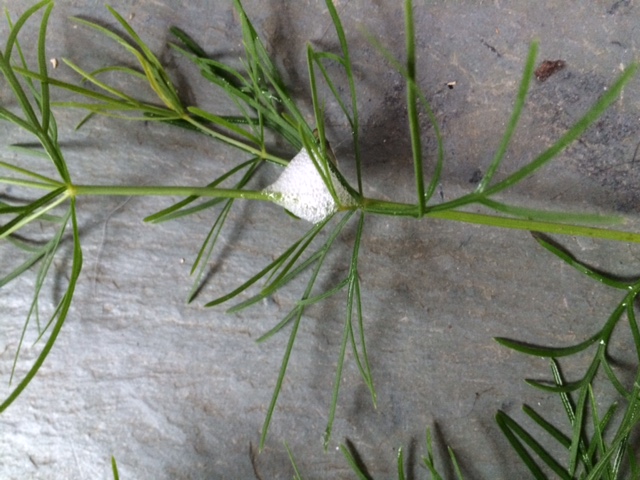
Yes Gwen, that big glob of spit-like stuff is the nursery of the 鈥渟pittlebug鈥� — or at least that鈥檚 what you call this life stage of a fascinating group of insects with virtually unpronounceable Latin names (Philaenus spumarius for the common meadow spittlebug). That soap-bubble-like froth is concealing a whole bunch of little creatures in the insect鈥檚 nymphal stage. They are sucking some juice out of the plant, but generally it鈥檚 not enough to cause any harm.
If you let them mature, they鈥檒l grow into , a really cool jumping bug that is the best leaper in the insect world relative to its body size. But if you don鈥檛 care to watch the high jump, there鈥檚 no need to reach for a chemical spray. I鈥檓 not even sure that sprays can reach the little buggers in there. The best way to eliminate the little spits is to spray the bugs off your plants with very sharp streams of water 鈥� the sharpest, most laserlike spray your nozzle can deliver.
Snake-nado: Get those snakes on a plane
There was a great story on 蜜桃视频app earlier this week about a family suing because the home they recently purchased on the Black rat snakes, to be specific. And they claim there was a seven footer in the basement.
Rat snakes can achieve a good length, but odds are good that like the fish that got away, a seven-foot snake will likely have shrunk down to around four feet by the time it鈥檚 captured.
As the story noted, these kinds of snakes, although scary, don鈥檛 hurt humans. But they do dine almost exclusively on rats, mice and other vermin 鈥� which had to be in abundance in that home or the snakes wouldn鈥檛 waste their time there. I don鈥檛 know about you, but I鈥檒l take a couple of snakes in the house over a family of rats any day.
Outdoors, it鈥檚 an even easier choice to not freak out at your free vermin control. Hey 鈥� I wonder if they ever take evil squirrels out to lunch?
It鈥檚 still safe to prune late bloomers like goldenrod
Beth in Silver Spring writes: 鈥淚s it possible to trim the long stalks of the Solidago named “Golden Fleece” that I planted last year to try to keep them from getting too tall and leggy? They’re only supposed to get about 18 inches tall but they’re that size now and still going. I’d like to keep them small if possible. But if I trim them now will I lose the flowers?鈥�

Well Beth, your 鈥渇leece of gold鈥� is a highly ornamental goldenrod cultivar, and all goldenrods bloom in late summer. So you can cut it back a bit now and you鈥檒l still get flowers on time.
But your 鈥渇leece鈥� is also a re-bloomer, so if you leave it alone now, you can cut the first run of flowers to bring inside for display and the plant will produce a second set of blooms shortly afterward. Your choice.
Oh, and although it gets a bad rap, goldenrod does not trigger fall allergies. It鈥檚 heavy pollen is carried by bees, not the wind.
Mosquito control advice: Yes, yes and point of information
蜜桃视频app鈥檚 own this week about outdoor mosquito control around the home, quoting a spokesman for the American Mosquito Control Association who wisely advised against the outdoor misting systems that constantly pump pesticide into the air and those old-school bug zappers that have long been shown to only fry moths and good bugs, not the little blood suckers. Excellent advice.
But then the spokesman cast a vote against the natural mosquito repelling sprays like garlic oil, cedar and oil of clove 鈥渂ecause they鈥檙e not EPA registered.鈥�
That鈥檚 splitting hairs. All three products fall under the EPA鈥檚 鈥�25 B鈥� category, meaning that their ingredients have been around a long time, are naturally derived and 鈥済enerally recognized as safe.鈥� Products that fall into this category are exempt from registration and are 100 percent legal.
Will Montgomery County fly a 鈥渄on鈥檛 spray on me鈥� flag?
All eyes will be on the Montgomery County Council a week from Monday as members once again debate bill 52-14, legislation that seeks to restrict the use of 鈥渃osmetic鈥� pesticides on Montgomery County lawns.
And no, cosmetic doesn鈥檛 mean applying lipstick to your fescue or giving your bluegrass a tummy-tuck. It means herbicides like Roundup, which has an active ingredient recently designated a 鈥減robable human carcinogen鈥� by the World Health Organization鈥檚 International Agency for Research on Cancer, and 2-4, D, which is under similar review right now.
Bottom line: Chemical herbicides are ineffective and unnecessary methods of weed control. Weeds will always appear in poorly cut, overfed lawns, and all the chemicals in the world can鈥檛 prevent it.
The only real and sustainable way to control weeds is to cut your lawn at the right height (that鈥檚 3 inches for the predominant cool-season grasses in our region) with a sharp blade (duh) and feed it gently at the correct times of year 鈥� which is spring and fall only for cool-season grasses, never, ever in the heat of summer.


